How to Optimize Your Gaming PC for Ray Tracing in 2026
Desktops
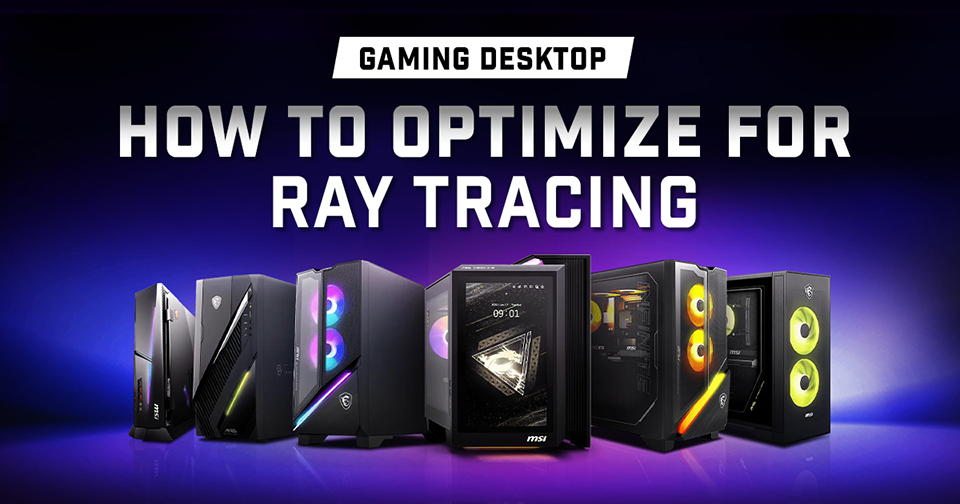
Quick Answer (TL;DR): Whether you're fine-tuning the best gaming desktop or unlocking the full potential of a new RTX 50 series gaming PC, optimizing for ray tracing (RT) comes down to smart settings. Confirm your GPU has dedicated RT hardware, update your drivers, enable DLSS or FSR, prioritize lighter ray-traced effects (shadows) over heavier ones (reflections, global illumination) if frame rate drops, and make sure cooling and power delivery can sustain boost clocks under load.
Step
Action
Why It Matters
1
Confirm GPU ray tracing support
No dedicated RT cores = unplayable frame rates
2
Update GPU drivers & game client
Fixes RT-specific or game-specific bugs and stutter
3
Prioritize which RT effects to enable
Reflections & Global Illumination cost far more than shadows
4
Enable DLSS or FSR
Recovers quite a bit of the performance lost to RT
5
Balance resolution with other settings
Resolution scales RT’s performance cost directly
6
Check cooling & power delivery
RT workloads demand sustained high GPU load
That's the short version. But if you’re looking for more detail, read on!
Quick Navigation:
- What Makes Ray Tracing So Demanding on Hardware?
- Step 1: Check GPU Support
- Step 2: Update Drivers and Game Client
- Step 3: Prioritize Which Ray-Traced Effects to Enable
- Step 4: Use DLSS or FSR
- Step 5: Balance Resolution and Other Settings
- Step 6: Cooling and Power Delivery
- FAQ
What Makes Ray Tracing So Demanding on Hardware?
Traditional rasterization approximates lighting using workaround techniques like baked shadows, screen-space reflection, and screen-space ambient occlusion.
Ray tracing, on the other hand, calculates the actual paths that light rays take as they bounce around a scene, which is what produces physically accurate reflections, soft shadows, and global illumination that feels more natural and immersive in a game environment. But this accuracy comes at a significant computing cost from the additional calculations per frame, which is why ray tracing needs a GPU with dedicated hardware (RT cores in RTX Graphics Cards are one example) built specifically to accelerate those calculations.
Step 1: Check If Your GPU Supports Ray Tracing
What are the Minimum GPU Requirements?
You’ll find Hardware Ray Tracing support on NVIDIA RTX GPUs (RTX 20-series or newer). That said, generational improvements matter a lot here: current-gen GPUs built using 4th-gen RT cores with neural rendering acceleration can run full path traced ray tracing, including global illumination, at more playable frame rates compared to previous-gen RTX cards. So, if you're shopping for a new system specifically for ray tracing, the GPU generation should be a key factor.
Step 2: Update Your GPU Drivers and Game Client
GPU manufacturers like NVIDIA regularly ship driver updates that may improve ray tracing efficiency or fix RT-related stuttering. You’ll find these labeled as "Game Ready" by NVIDIA. Outdated drivers are one of the most common, and most overlooked, causes of inconsistent gaming performance, especially with new tech like DLSS and Ray Tracing. That’s exactly why it’s worth checking for updates to your GPU driver, Windows, and your game launcher (Steam, Epic Games, etc.) before touching any in-game settings.
Step 3: Prioritize Which Ray-Traced Effects to Enable
Ray-Traced Shadows vs Reflections vs Global Illumination: Performance Cost Compared
Not every ray-traced effect costs the same, so if your frame rate drops after enabling ray tracing, you don't have to turn it off entirely — you can try selectively disabling the most expensive effects first.
Ray-Traced Effect
Performance Cost
Visual Impact
Shadows
Low
Noticeable, especially in shadow edges and contact points
Reflections
Medium–High
Most visible on glass, water, metal surfaces
Global Illumination
High
Largest overall visual leap; most demanding
Ambient Occlusion (RT)
Low–Medium
Subtle but consistent realism boost
A practical approach: if you need to recover frame rate, disable global illumination first, then reflections. We’d recommend keeping ray-traced shadows enabled as they deliver a strong visual upgrade for a relatively small performance cost.
Step 4: Use DLSS or FSR to Offset the Performance Cost
How Frame Generation Helps Ray Tracing
Upscaling tools render the game at a lower internal resolution and reconstruct it at your display's native resolution. This leaves your GPU much more breathing room to handle RT workloads. The latest generation of graphics cards go further: NVIDIA's DLSS 4.5, for example, brings an improved transformer model and up to 6x Multi-Frame Generation to claw back performance from the extreme demands of modern games. However, some of these features can only be used by newer RTX 50-Series graphics cards.
AMD's FSR for Radeon and Intel’s XeSS offer similar upscaling features in several games with broader GPU compatibility, albeit at a slight loss of quality.
In almost every case, enabling DLSS or FSR before disabling any ray-traced effect is the better trade-off because you keep the visual upgrade and recover most of your frame rate.
Step 5: Balance Resolution and Other Settings
Should You Lower Resolution Before Disabling Ray Tracing?
Resolution and ray tracing, like many heavier graphics settings, compound the performance cost as every additional pixel means additional light calculations. If you're choosing between dropping from 4K to 1440p versus disabling ray-traced reflections, the right choice comes down to personal preference.
We’d recommend dropping the resolution for a bit and play with Ray Tracing ON to see whether the added realism makes up for the loss of clarity.
But keep in mind: some monitors aren’t built to handle resolutions other than their native resolution, so this might offer a sub-par gaming experience even at a higher frame rate. It’s better to disable Ray Tracing in such cases.
Step 6: Check Cooling and Power Delivery for Sustained RT Performance
Ray tracing doesn't just demand more processing power in short bursts; it tends to keep the GPU pegged at high loads for the duration of gameplay, which means thermal management matters more here than it does for lighter gaming workloads.
A GPU that thermal-throttles after 20 minutes will offer worse real-world ray tracing performance than its benchmark numbers suggest. This is one of the reasons system airflow design has become a real differentiator in prebuilt gaming desktops that leverage features like separated air chambers per component and AI-driven fan curves to sustain boost clocks longer than a comparable system with more generic case airflow. It’s exactly why we’ve invested a ton of thermal design and engineering into MSI’s Silent Storm Cooling AI in prebuilt gaming desktops.
FAQ
Does ray tracing always need DLSS to run well?
Not strictly, but in most cases it's an effective way to recover the performance cost of ray tracing with only a minimal, and often unnoticeable loss in visual quality, especially at 1440p and above.
Which ray-traced effect should I disable first if my FPS drops?
Global illumination. Since it's the most computationally demanding of the three core ray-traced effects, it makes most sense to start here. Reflections are the next to go, but shadows are usually worth keeping on unless your FPS is still dipping.
Is ray tracing worth it on a 1080p display?
Yes! Ray tracing's performance cost scales with resolution, so it's actually more sustainable at 1080p than at 4K, making it a viable option even on mid-range hardware. As for visuals, yes, you’ll see more detail at higher resolutions, but the visual upgrade in some scenes will still be very noticeable.
Do prebuilt gaming desktops come pre-optimized for ray tracing?
Many current prebuilt systems ship with up-to-date GPU drivers, next-gen graphics cards, optimized BIOS settings, and airflow already tuned for sustained performance, which removes most of the manual setup described above. That said, it's still worth checking for driver updates periodically.
Want to see how each ray-traced effect actually breaks down setting by setting? Check out Every Graphics Setting Explained. Or, if you're starting from scratch rather than upgrading, here's what to look for in a ray tracing–ready prebuilt gaming desktop.